
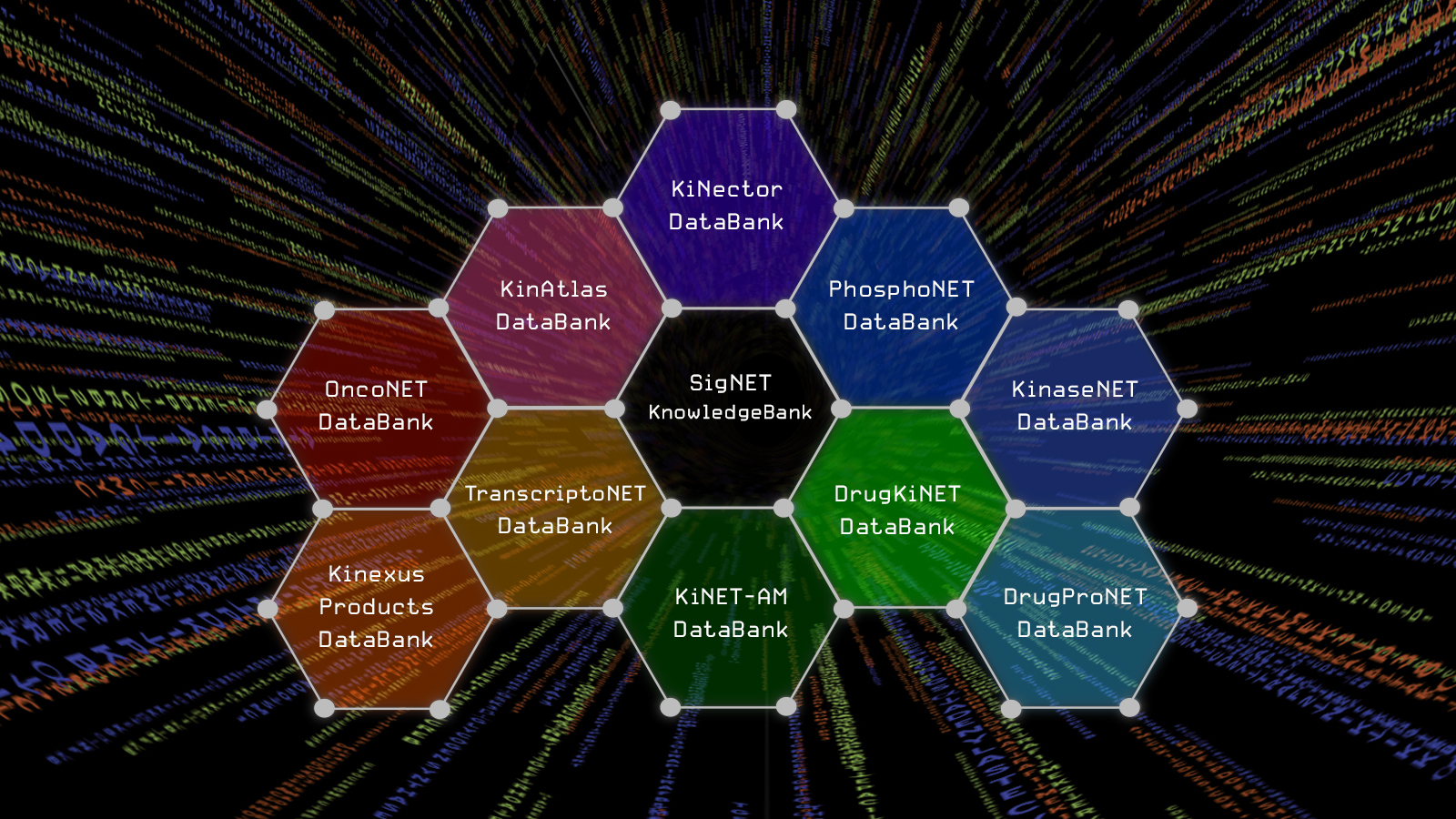
Over the last 20 years, Kinexus has been slowly creating our SigNET KnowledgeBank, which is a growing collection of cell signalling-related knowledge bases produced by Kinexus with the aid of graduate students from the University of British Columbia and computer science students from the British Columbia Institute of Technology. These are open access websites that collectively feature millions of webpages. We have designed these websites to be comprehensive, but easy to navigate, which is not an easy task in view of the complexity of cell signalling systems and the rapid accumulation of new information in the scientific literature.
It is our hope that the SigNET KnowledgeBank will not only be helpful to established biomedical scientists in their research, but that it will be useful to novice students that are embarking in a career in pursuit of basic and applied research in the biological and health sciences.
Updating these websites is a constant challenge with our limited resources. However, the application of predictive algorithms, for example as with PhosphoNET to predict new human phosphosites, ensures that with confirmation of their discovery, there is already useful information to explore their conservation in evolution and potential protein kinases that may target these phosphosites. While our predictive algorithm are not perfect, they are very useful starting place to develop testable hypotheses, which Kinexus can assist with our products and services.
While our knowledge of cell signalling systems continues to advance, at least the cell signal transduction networks are highly conserved and relatively stable in evolution. Consequently, what we learn from each new experiment brings us a sharper focus with respect their composition and architect, and when they go awry from genetic mutations and the actions of toxins resulting in disease, what strategies may be implemented for their therapeutic intervention.